
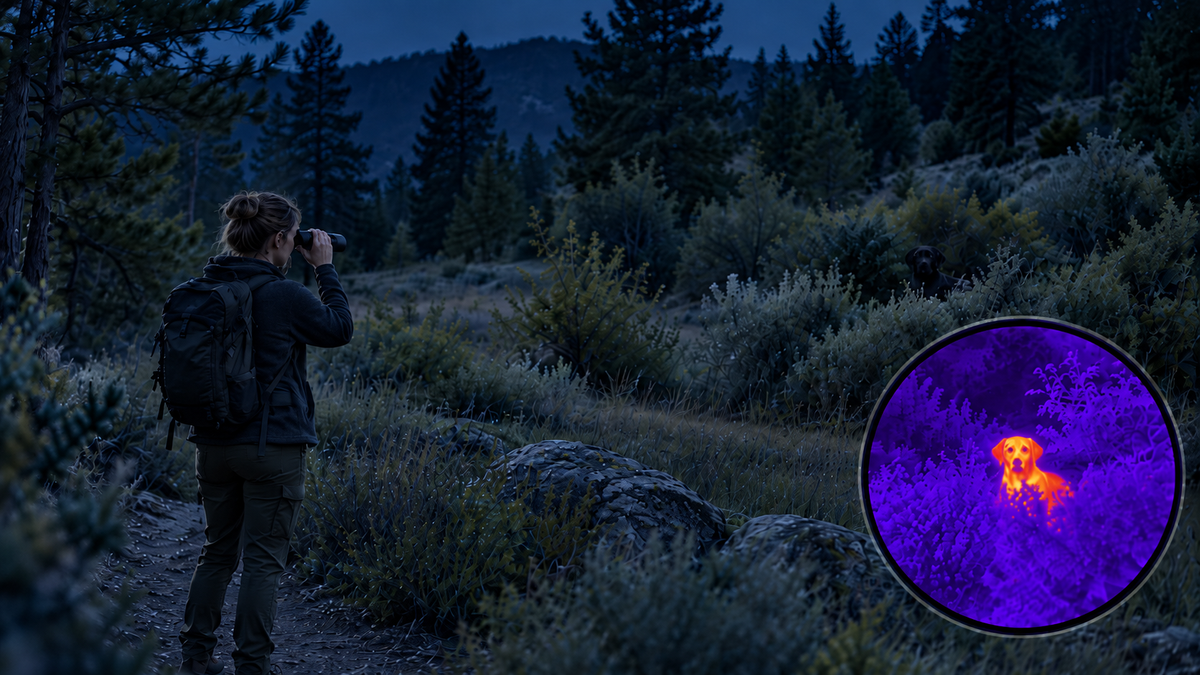
A handheld thermal imaging device can help during a nighttime search for a lost dog, cat, or other warm-blooded animal by making heat differences easier to notice in darkness.
It is especially useful for scanning yards, open grass, tree lines, brush edges, sheds, rural property, and other outdoor areas where an animal may be visually difficult to see.
Thermal imaging should be treated as an additional search tool, not a guarantee.
It cannot see through walls, solid tree trunks, closed doors, dense structures, or most glass.
Thick vegetation can hide much of an animal’s heat pattern, and warm weather can reduce contrast between an animal and the background.
The most effective search combines fast local action, neighbors and community contacts, shelters and veterinary facilities, current identification information, conventional lighting when appropriate, and a careful thermal scan of places where an animal could be resting or hiding.
Start With the Basics Before Relying on Technology
When a pet goes missing, speed and organization matter more than any single device.
The ASPCA recommends first checking the home carefully, then alerting neighbors and searching nearby areas.
The organization also recommends contacting animal control agencies, shelters, veterinary facilities, and rescue groups.
The American Kennel Club similarly advises beginning a local search promptly and using familiar sounds, food, toys, and people the dog knows.
These steps remain essential even if you own a thermal monocular.
A thermal device can help you scan dark outdoor spaces, but it cannot tell a shelter that your pet is missing, update a microchip record, or replace neighbors who may have seen the animal move through the area.
Think of thermal imaging as a way to improve visual coverage after dark while the broader recovery effort continues in parallel.
Why Nighttime Searches Are Difficult
Darkness changes the search problem in several ways.
First, visual contrast disappears.
A dark-colored dog near bushes or a cat under a porch may blend almost completely into the background.
Second, ordinary flashlights illuminate only the area where the beam is pointed.
A person can walk past an animal that is sitting quietly outside the beam.
Third, a frightened animal may not behave normally.
Some pets respond to their name; others remain silent, hide, or move away from unfamiliar people.
Searchers therefore need to look for the animal rather than assume it will respond.
Thermal imaging addresses the first two problems by displaying infrared energy rather than visible color.
A warm animal can stand out as a different thermal pattern even when the surrounding area looks uniformly dark to human eyes.
How Thermal Imaging Works in a Pet Search
Thermal cameras detect infrared energy emitted by objects and convert temperature differences into a visible image.
NASA explains that warm objects, including people and animals, emit infrared energy that human eyes cannot see.
A handheld thermal monocular can therefore be used to scan a dark scene for warm shapes.
Instead of looking for fur color, reflective eyes, or motion in visible light, the user is looking for thermal contrast.
That can be helpful in places such as a backyard, pasture, roadside edge, open lot, wooded boundary, or area around outbuildings.
The strongest results occur when enough of the animal is visible to the sensor and there is meaningful temperature contrast between the animal and the surroundings.
Where Thermal Imaging Can Be Most Useful
Thermal scanning works best when you have a clear line of view across an area where the pet may be present.
Open grass is one of the easiest environments because a warm animal can stand out clearly against cooler ground, especially later at night or before sunrise.
Property edges can also be productive because lost animals may pause near fences, shrubs, drainage areas, parked equipment, or quiet transition zones.
Tree lines and light brush can be useful to scan because an animal resting near the edge may expose enough of its body to create a recognizable heat shape.
Around farms and rural properties, users can scan pasture edges, barn exteriors, fence lines, water areas, equipment rows, and sheltered spaces that remain visually accessible.
In suburban areas, useful locations include yards, alleys, under open porches, around sheds, behind landscaping, and along quiet paths between properties, subject to local access rules and permission.
Thermal Imaging Cannot See Through Solid Objects
One of the most important expectations to set is that thermal imaging does not see through walls.
Teledyne FLIR explains that a thermal camera detects the infrared energy reaching it from a surface.
If a dog is inside a closed shed, the device generally shows the outside surface of the shed, not the dog inside.
The same principle applies to walls, fences without gaps, tree trunks, vehicles, and other solid barriers.
Thermal imaging also does not provide a normal view through standard glass.
Glass strongly reflects long-wave infrared energy, so the thermal display may show reflected heat rather than what is on the other side.
This means a thermal scan must be paired with a physical search of enclosed spaces that can be checked safely and legally.
Vegetation Can Hide a Pet
A thermal camera cannot remove leaves, branches, grass, or other material from the line of view.
Research published through the U.S. Geological Survey found that thermal detectability of animals can decrease as vegetation coverage increases.
The exact result depends on the animal, sensor, distance, vegetation density, and environmental conditions.
For a lost-pet search, this means dense bushes should not be cleared as “empty” simply because no obvious heat shape appears.
Scan from several angles, move slowly, and use conventional visual inspection where safe.
A partial heat pattern may be the only visible clue.
An ear, head, part of the torso, or a warm opening between leaves can look different from the full-body shape shown in product demonstrations.
Temperature Contrast Changes Through the Night
Thermal performance depends heavily on contrast between the animal and the surrounding surfaces.
After a hot sunny day, pavement, walls, rocks, roofs, vehicles, and bare soil may remain warm for hours.
Those surfaces can create a busy thermal scene and make a warm animal less obvious.
Later in the night, many surfaces cool and the animal may become easier to distinguish.
Before sunrise can be especially useful in some environments because solar heating has been absent for many hours.
Warm, humid conditions can reduce thermal contrast.
Rain and fog can also affect the infrared energy reaching the sensor.
A search that produces little useful information at one time of night can therefore look different several hours later.
Start Close to the Last Confirmed Location
A practical search should begin with the most recent reliable location rather than immediately covering a huge area.
Search the home, garage, yard, immediate street, common walking route, nearby hiding spaces, and places the pet already knows.
Speak with neighbors and ask them to check spaces you cannot access.
The American Kennel Club recommends beginning a local search promptly and expanding based on what you learn.
The exact search area should depend on the species, age, temperament, health, environment, elapsed time, and reliable confirmed reports.
For thermal use, divide the nearby area into manageable zones and scan each zone methodically.
This is more effective than moving quickly and repeatedly viewing the same easy areas.
Use a Repeatable Scan Pattern
A systematic scan reduces the chance of missing a quiet animal.
Begin with the closest open area and move the thermal view slowly from one side to the other.
Overlap each pass slightly.
Pause on warm shapes instead of assuming immediately that they are the missing pet.
Then change your viewing angle.
A heat pattern hidden by a bush from one position may become visible from another.
Next, check edges: under open structures, along fences, beside vegetation, around parked objects, and near places that provide shelter from wind or rain.
Finally, repeat the scan after a short interval if the area remains plausible.
A pet that was hidden may move into view.
The purpose is not to cover ground as fast as possible.
The purpose is to reduce unobserved space.
How to Interpret a Heat Signature Carefully
Not every warm shape is the missing animal.
Cats, dogs, raccoons, rabbits, birds, people, warm machinery, vents, recently parked vehicles, compost piles, and sun-warmed surfaces can all create noticeable thermal patterns.
Shape and movement can provide clues, but confident identification may still require a conventional view from a safe distance.
If the heat signature is partly hidden, avoid making assumptions.
Continue observing and reposition if safe.
Digital magnification can make an image larger, but it does not create information that the sensor did not capture.
A higher-resolution thermal device can provide more spatial detail, yet even a 640-class sensor cannot guarantee identification when the animal is far away or heavily obscured.
384 or 640 for Locating Animals After Dark?
Both can be useful.
A 384-class thermal monocular can provide strong value for yards, neighborhoods, farms, paths, and moderate observation distances.
If the main need is detecting a warm animal and moving through multiple areas, portability and field of view may matter more than maximum resolution.
A 640-class device provides more detector pixels and can show more shape detail when the lens systems and conditions are comparable.
That extra information may be helpful on larger rural properties or when the animal is farther away.
Resolution should still be considered with NETD, lens design, focus, display quality, weight, battery life, controls, and field of view.
Keep the Search Calm and Safe
A missing animal may be frightened or disoriented.
Loud groups, sudden movement, vehicle traffic, bright light, and unfamiliar people can sometimes make a nervous pet harder to approach.
Coordinate searchers rather than sending everyone randomly in different directions.
Share confirmed information, time-stamp confirmed reports, and avoid spreading unverified assumptions.
Do not enter private property without permission.
Avoid unsafe roads, unstable structures, bodies of water, and unfamiliar terrain in darkness.
If the pet is near traffic or another hazard, contact appropriate local services for assistance.
If you see the animal, consider its temperament before approaching.
A calm, familiar person with food or a known object may be more effective than several people moving toward it at once.
Thermal Imaging Is Most Useful as Part of a Broader Recovery Plan
The strongest recovery effort combines technology with communication.
Maintain current microchip and identification information.
Contact local shelters, veterinary facilities, animal control agencies, rescue groups, neighbors, property managers, and community networks.
Share a recent clear photo and accurate contact information.
Continue checking ordinary hiding spaces during daylight.
Review available doorbell or property camera footage.
Ask nearby residents to inspect garages, sheds, crawl areas, porches, and fenced spaces.
Use thermal imaging to improve nighttime visual coverage, especially in open or semi-open spaces.
It can add a valuable layer to the search without replacing the rest of the plan.
Common Mistakes to Avoid
The first mistake is assuming the device can see through walls or dense cover. It cannot.
The second is scanning too quickly. Small or partly hidden heat patterns are easy to miss when the view moves rapidly.
The third is assuming every warm animal-shaped form is the missing pet. Confirm carefully.
The fourth is focusing only on distant areas. Many animals remain surprisingly close to the place they disappeared but stay hidden or silent.
The fifth is searching alone without telling others what areas have already been checked. Coordination prevents duplicated effort and missed zones.
The sixth is relying on technology while delaying calls to shelters, neighbors, and veterinary facilities. Those steps should begin immediately.
Frequently Asked Questions
Can Thermal Imaging Find a Dog in Complete Darkness?
It can help detect a dog’s heat signature in complete darkness when the animal is within the device’s useful observation conditions and is not blocked by solid objects or dense cover.
Actual performance depends on temperature contrast, distance, lens design, resolution, sensitivity and weather.
Can a Thermal Monocular See a Cat Under a Porch?
Only if the sensor has a line of view to enough of the cat’s body or heat pattern.
Solid boards, walls and other barriers block the direct infrared view.
Can Thermal Imaging See Through Bushes?
Not in the literal sense.
Gaps in vegetation may allow part of an animal’s heat pattern to reach the sensor, while dense leaves and branches can hide it.
Scanning from several angles can help.
Does Thermal Imaging Work Through a Window?
Standard glass is generally not transparent to the long-wave infrared energy used by common handheld thermal devices.
The display can show reflections from the glass rather than a normal view through it.
Is Nighttime Always the Best Time to Use Thermal Imaging for a Lost Pet?
Darkness removes the need for visible-light viewing, but thermal contrast is what matters most.
In many environments, later at night or before sunrise can provide stronger contrast than immediately after a hot day.
Conditions vary.
Should Thermal Imaging Replace Normal Lost-Pet Steps?
No.
It should supplement immediate local searching, neighbor outreach, shelter and veterinary contacts, identification updates, community notices, and other established recovery methods.
Final Takeaway
Thermal imaging can be a useful addition to a nighttime lost-pet search because it changes the visual problem from “Can I see the animal’s color and shape in darkness?” to “Can I detect a meaningful heat difference in this scene?”
That advantage is real, but so are the limitations.
Thermal devices do not see through solid objects, vegetation can obstruct the view, glass behaves differently in infrared, and warm weather can reduce contrast.
Use the technology systematically.
Start close to the last confirmed location, scan slowly, change angles, inspect likely hiding places, coordinate with other searchers, and keep the broader recovery network active.
For users who want a compact way to scan outdoor areas after dark, a handheld thermal monocular can provide valuable additional visibility when used with realistic expectations.
Explore PardVision thermal monoculars to compare resolution, field of view, NETD, battery life and physical design for nighttime animal search and outdoor observation.
Share:
384 vs 640 Thermal Monocular: What Resolution Really Changes