
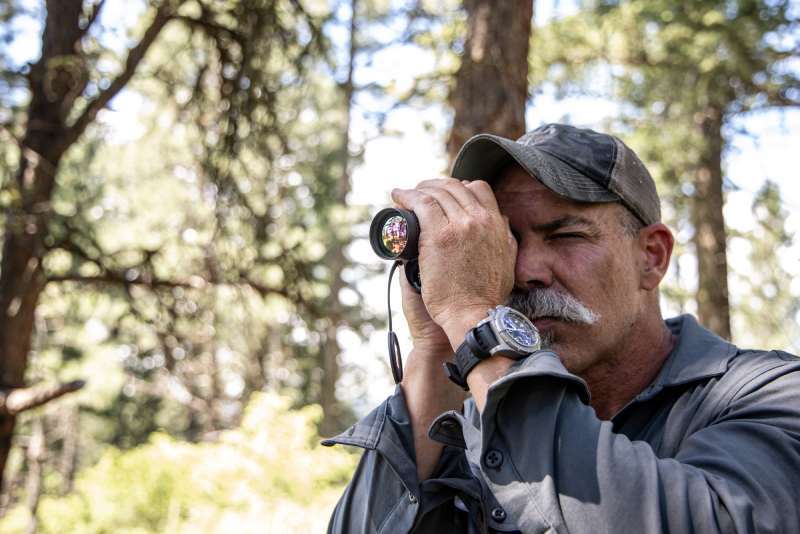
A 640-class thermal sensor contains far more detector pixels than a 384-class sensor, so it can provide more image detail when the lens system, field of view, sensitivity, processing and viewing conditions are comparable.
A common 384 × 288 sensor contains 110,592 detector pixels, while a 640 × 512 sensor contains 327,680—almost three times as many.
That does not mean every 640 thermal monocular is automatically the better purchase.
A 384 model can be an excellent choice for general wildlife observation, camping, ranch use and nighttime outdoor viewing, especially when portability and budget matter.
A 640 model becomes more compelling when the user values finer detail, wants to observe larger landscapes, uses digital magnification more often, or wants more visual information at a given observation distance.
Resolution is important, but it should be evaluated together with field of view, lens focal length, NETD, pixel pitch, focus, display quality, battery life, weight and software processing.
What Does 384 or 640 Mean in a Thermal Monocular?
The number usually refers to the approximate horizontal resolution of the thermal detector.
Many handheld devices use formats around 384 × 288 and 640 × 512, although exact formats vary by manufacturer and model.
Each detector pixel samples infrared energy from a small part of the scene.
More pixels allow the system to describe the scene with more spatial information. This can improve the visible shape of animals, branches, terrain edges and other heat patterns when the rest of the imaging system supports that detail.
Teledyne FLIR explains the principle simply: higher thermal resolution provides more pixels on the scene, which can increase the amount of usable detail.
The company also emphasizes that resolution is only one part of a thermal imaging system.
For buyers, that means the label “640” should not be treated as a complete performance score.
It is a major specification, not the entire answer.
Pixel Count: The Most Obvious Difference
The arithmetic helps explain why 640 imagery can look more detailed.
| Sensor Format | Detector Pixels | Relative Pixel Count |
|---|---|---|
| 384 × 288 | 110,592 | 1.0× |
| 640 × 512 | 327,680 | About 3.0× |
With comparable lens systems and field of view, those extra pixels can place more samples across the same animal or landscape feature.
More samples can improve shape definition and reduce the blocky appearance that becomes noticeable when an image is enlarged.
The benefit is especially easy to notice when viewing smaller animals, observing across open land, or using digital magnification.
Why Resolution Is Not the Same as Detection Distance
A common buying mistake is to assume that more pixels automatically mean a device can detect heat at a dramatically greater distance.
Detection distance depends on several variables: the size of the animal or object, lens focal length, field of view, sensor resolution, thermal sensitivity, weather, temperature contrast, atmosphere and the criteria used by the manufacturer to define detection.
Teledyne FLIR notes that the question “how far can I see?” cannot be answered by one specification because the size of the observed object, lens design, pixel coverage, environment and temperature difference all matter.
A 640 device may preserve more detail at distance, but a 384 device with a different lens can have a very different viewing geometry.
Comparing only sensor resolution can therefore be misleading.
When shopping, compare the complete imaging system rather than assuming that one number determines real-world viewing distance.
Field of View Can Matter as Much as Resolution
Field of view describes how much of the scene is visible at one time.
It is influenced primarily by sensor size and lens design.
A wider field of view helps users scan broad areas more efficiently.
It can be particularly useful around forests, ranches, campsites, property edges and other environments where animals may appear at unpredictable positions.
A narrower field of view shows less of the scene at once, but a suitable lens can make distant subjects occupy more of the image.
This creates an important tradeoff.
Two thermal monoculars with the same detector resolution can feel completely different outdoors if their fields of view are different.
Likewise, a 640 model with a relatively wide field of view may provide a combination of broad scene coverage and useful detail that would be difficult to match with a lower-resolution detector.
For practical comparison, always look at resolution and field of view together.
Lens Focal Length Changes the Viewing Experience
Lens focal length is another major variable.
Longer focal lengths generally produce a narrower view and make distant subjects appear larger.
Shorter focal lengths generally produce a wider view that is easier to scan at closer distances.
That is why the best focal length depends on the environment.
For wooded trails, livestock areas, campsites and pet search, a wider view can make it easier to cover nearby space quickly.
For broad open landscapes, a narrower view may be more useful when the main goal is observing activity farther away.
A 384 device with the right lens for a specific use can therefore feel more effective than a 640 device configured for a very different viewing style.
What Higher Resolution Does for Digital Magnification
Digital magnification enlarges part of the sensor image.
It does not create new detector information.
When you enlarge a 384 image, fewer original pixels are available in the cropped area.
When you enlarge a 640 image by a similar amount, the starting image contains more pixels, so the result generally retains more visual information.
This is one of the strongest practical reasons to consider 640 if you expect to use digital magnification frequently.
However, digital magnification still cannot replace a suitable lens system.
Once the device enlarges the image beyond the available sensor information, softness and pixelation increase.
Higher resolution delays that loss of detail. It does not eliminate it.
NETD: Why Thermal Sensitivity Matters
Resolution tells you how many detector pixels are available.
NETD tells you something different: how small a temperature difference the system can distinguish above its own noise.
NETD stands for Noise Equivalent Temperature Difference and is usually expressed in millikelvins, or mK.
Teledyne FLIR describes lower NETD values as generally indicating better thermal sensitivity.
Why does that matter outdoors?
Consider a warm, humid evening when vegetation, ground surfaces and an animal are relatively close in temperature.
A more sensitive thermal system can have an advantage in separating subtle temperature differences and preserving useful texture in the scene.
This means a lower-resolution device with strong thermal sensitivity can sometimes produce a more pleasing or useful image than a higher-resolution device with weaker sensitivity, depending on the environment and overall design.
Resolution and NETD answer different questions.
Good buying decisions consider both.
Environmental Contrast Can Change the Image Dramatically
Thermal images often look most striking when there is a strong temperature difference between an animal and the background.
When the entire environment is thermally similar, the scene may appear flatter.
Time of day can change this contrast.
Ground, rocks, buildings, tree trunks and water absorb and release heat at different rates.
After a sunny day, some surfaces can remain warm well after sunset. Before sunrise, the same location can present a very different thermal pattern.
Humidity, fog and rain can also reduce performance.
Water droplets can interfere with infrared transmission, and a wet environment may compress temperature differences.
This is why product demonstrations made in cool, dry conditions should not be treated as a guarantee of identical performance every night of the year.
384 Thermal Monocular: Where It Makes Sense
A 384-class device can offer a strong balance of image quality, portability and cost for many users.
It is often well suited to general wildlife observation, nature viewing, camping, farm and ranch use, checking animal activity around a property, and locating pets after dark.
At common observation distances, a good 384 system can provide clear heat-based awareness without requiring the cost of a higher-resolution detector.
For users who mostly scan relatively close environments and do not rely heavily on digital magnification, the practical difference between a good 384 device and a more expensive 640 device may be smaller than expected.
A 384 model can also be attractive as a compact device that is carried often.
A technically superior device provides little benefit if its size, weight or cost means it stays at home.
640 Thermal Monocular: Where the Extra Detail Matters
A 640-class device becomes more valuable when detail is a priority.
The extra detector pixels can improve the visible outline of animals and landscape features, especially when the field of view and lens system are well matched.
Users who observe across larger open areas may appreciate the added information.
Wildlife photographers may also find the additional detail useful when deciding where to position conventional camera equipment from a respectful distance.
The higher starting resolution is also helpful for digital magnification.
A cropped 640 image begins with more source information than a similarly cropped 384 image.
For frequent users, the increase in visual comfort and confidence can justify the additional cost.
But the purchase still should be based on the complete device, not the sensor number alone.
384 vs 640 for Wildlife Observation
For wildlife observation, think in terms of three steps: finding activity, understanding what you are seeing, and maintaining responsible distance.
A 384 device can be very effective at the first step when the animal is sufficiently warm relative to its surroundings.
A 640 device can make the second step easier by providing more shape information, especially when the animal occupies a smaller part of the scene.
Neither resolution removes the need for careful identification.
A small heat signature at a long observation distance can still be ambiguous.
Vegetation, posture, partial visibility and environmental conditions can all make species identification difficult.
The National Park Service recommends observing wildlife from a safe distance and backing away if an animal reacts to your presence.
Higher-resolution observation equipment should be used to maintain distance, not to justify approaching wildlife more closely.
A Better Way to Compare Thermal Monoculars
Instead of asking only “384 or 640?”, start with the real environment.
Consider whether you primarily observe in woods, across open property, around a campsite, near livestock areas, beside water, or in mixed terrain.
Then decide whether broad scanning or distant detail matters more. This helps you interpret field of view and lens focal length.
Next, compare detector resolution. Higher resolution provides more spatial information when other variables are comparable.
Then compare NETD and image processing. Sensitivity can matter greatly in low-contrast thermal scenes.
Finally, evaluate weight, battery life, controls, recording, focus, display and weather resistance.
These features determine whether a device is pleasant to use repeatedly.
Quick Comparison Table
| Decision Factor | 384-Class Thermal | 640-Class Thermal |
|---|---|---|
| Detector information | Good | Significantly higher |
| Detail with comparable lens design | Good | Better |
| Digital magnification | Useful; detail falls sooner | Retains more information |
| General outdoor observation | Strong value | Premium experience |
| Large open landscapes | Capable | Often more comfortable for detail |
| Portability | Often excellent | Varies by model |
| Cost | Lower | Higher |
| Best buyer | Value-focused observer | Detail-focused frequent observer |
Frequently Asked Questions
Is 640 Three Times Better Than 384?
No.
A common 640 × 512 detector has almost three times the pixels of a 384 × 288 detector, but user experience does not improve in a simple three-to-one ratio.
Lens design, field of view, NETD, processing, display and environmental conditions all influence the final image.
Is a 384 Thermal Monocular Enough for Wildlife Observation?
For many users, yes.
A well-designed 384 device can be very effective for locating and observing animals at practical distances, especially in environments where a wide view and portability matter.
When Is 640 Worth Paying More For?
640 is easier to justify when you value finer image detail, observe large open spaces, use digital magnification frequently, or use the device often enough to appreciate the improved visual information.
Does Lower NETD Matter if I Already Have 640 Resolution?
Yes.
Resolution and sensitivity describe different aspects of performance.
A 640 sensor provides more spatial samples, while NETD describes the ability to distinguish small temperature differences.
Both matter.
Does a Longer Lens Always Improve a Thermal Monocular?
No.
A longer focal length generally narrows the field of view.
That may help with distant observation but can make nearby scanning slower and more difficult.
The right lens depends on the environment.
Final Takeaway
The practical difference between 384 and 640 thermal monoculars is not simply “basic versus premium.”
It is a tradeoff between detector information, lens design, field of view, thermal sensitivity, portability and cost.
A 384 device can be an excellent everyday observation tool.
A 640 device gives the imaging system more detector information to work with and can provide a meaningful improvement in detail when the rest of the system is well designed.
Start with your environment and observation style, then evaluate resolution in context.
That approach produces a better purchase decision than choosing by the largest number on a specification sheet.
Explore PardVision thermal monoculars and compare resolution, field of view, NETD, battery life and physical design to find the configuration that matches your outdoor observation needs.
Share:
Thermal Imaging vs Digital Night Vision for Wildlife Observation: What Is the Difference?
How Thermal Imaging Can Help Find a Lost Pet at Night